Caricamento carrello…
 Loading...
Loading...
Loading...Mongolian cashmere waste – sustainable creativity.
Rehab breathes new life into quality fibers and yarns, transforming scraps and leftovers into sustainable, creative materials ready to inspire your craft projects.
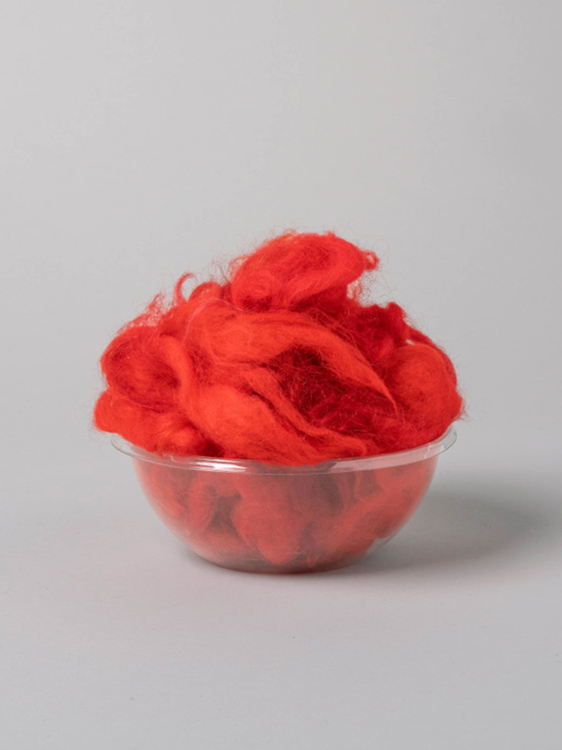
Mongolian cashmere waste represents a meeting of luxury and sustainability, offering a fine fiber born from the recovery of selected materials from cashmere production processes. Soft, light and naturally refined, these laps retain the distinctive qualities of the original fiber, transforming into a creative resource capable of giving new life to a noble material. Ideal for felting, spinning and textile experimentation, they embody a contemporary vision of the fiber: responsible, precious and rich in expressive potential. Cashmere waste is also part of the Rehab selection. Purchasing these materials means making a sustainable choice because this approach not only helps reduce waste but also provides an opportunity to explore new creative and sustainable combinations.
Please note: inside each package you will find laps of the same color (e.g. PINK) but in different shades. And that’s really the beauty of this product! Such a palette of colors has never been seen before! While the packs of assorted colors will contain at least 2 colors.
Availability and packaging
Mongolian cashmere waste is available in 500 g packs per color. Each package has a natural tolerance of ±3%. For non-ECE shipments, the packages are vacuum-packed, reducing volume and lowering shipping costs. Don’t worry: once opened, the fiber returns to its original, fluffy volume with no loss of quality.
Mongolian cashmere waste (about 13 microns).
Cashmere waste consists of fine, soft fibers, generally with a very small diameter (about 13 microns), which retain the typical softness and insulating capacity of cashmere. The texture is soft and airy, with fibers of varying lengths due to the recovery and processing process, a characteristic that contributes to textured, rich surfaces. Despite originating from selected waste, the fiber retains the tactile and thermal qualities typical of cashmere.
Cashmere waste comes from fibers recovered during the cashmere processing and manufacturing processes that take place in our production facilities, materials that would otherwise be discarded. Through sorting and reuse operations, these fibers are transformed into a new textile raw material, helping to reduce waste and extend the life cycle of a valuable fiber. The original cashmere comes mainly from goats raised in Central Asian regions such as Mongolia and China, territories characterized by harsh climates that favor the development of a particularly fine, insulating undercoat.
The dyeing of fibers is carried out in our dyehouse in Italy, in compliance with current European regulations on chemical substances and environmental safety, including the REACH Regulation (EC No. 1907/2006), which governs the registration, evaluation, authorization and restriction of chemical substances.
Operating within the European Union also entails compliance with additional provisions on environmental protection and textile product safety, such as the CLP Regulation (EC No. 1272/2008), relating to the classification, labeling and packaging of substances and mixtures. This regulatory framework ensures that dyeing processes are conducted according to high standards of safety, traceability and environmental responsibility, offering a reliable product for both the end user and the environment.
Mongolian cashmere waste yarns are a discontinuous and irregular fiber, so they lend themselves primarily to techniques in which texture and yarn variability are an added value.
They are ideal for artisanal spinning, either spindle or spinning, often blended with other natural fibers such as wool or cotton to improve cohesion and workability. Once spun, they can be used for knitting or crocheting, where they return soft, slightly irregular yarns that are very rich in texture.
They can also be used for needle felting or water felting techniques, where they integrate well with wool due to their fibrous structure, or for textile art interventions and three-dimensional decorations.
In general, they are designed for non-standardized processing, where the fiber is enhanced precisely in its free and non-regular nature.
Want to check the quality of the material? Choose our Sample Box.
CAUTION: All of our colors generally exhibit high lightfastness and wash fastness. However, fluorescent colors (80's collection), in addition to having a lower lightfastness, may also suffer significant color loss in the presence of alkaline or particularly aggressive soaps, as well as with prolonged processing or washing. This phenomenon can occur, to varying degrees, even with dark and particularly bright colors. For materials dyed with these shades, we always recommend that a preliminary processing and washing test be carried out on a small sample before making the final design. This precaution is essential, especially when dyed materials are combined with unbleached or light-colored fibers.
Finally, to best preserve the colors, it is recommended that artifacts not be dried in direct sunlight, but in a shady place.