Caricamento carrello…
 Loading...
Loading...
Loading...Silk sari ribbons – sustainable creativity.
Rehab breathes new life into quality fibers and yarns, turning scraps and leftovers into sustainable, creative materials ready to inspire your craft projects.
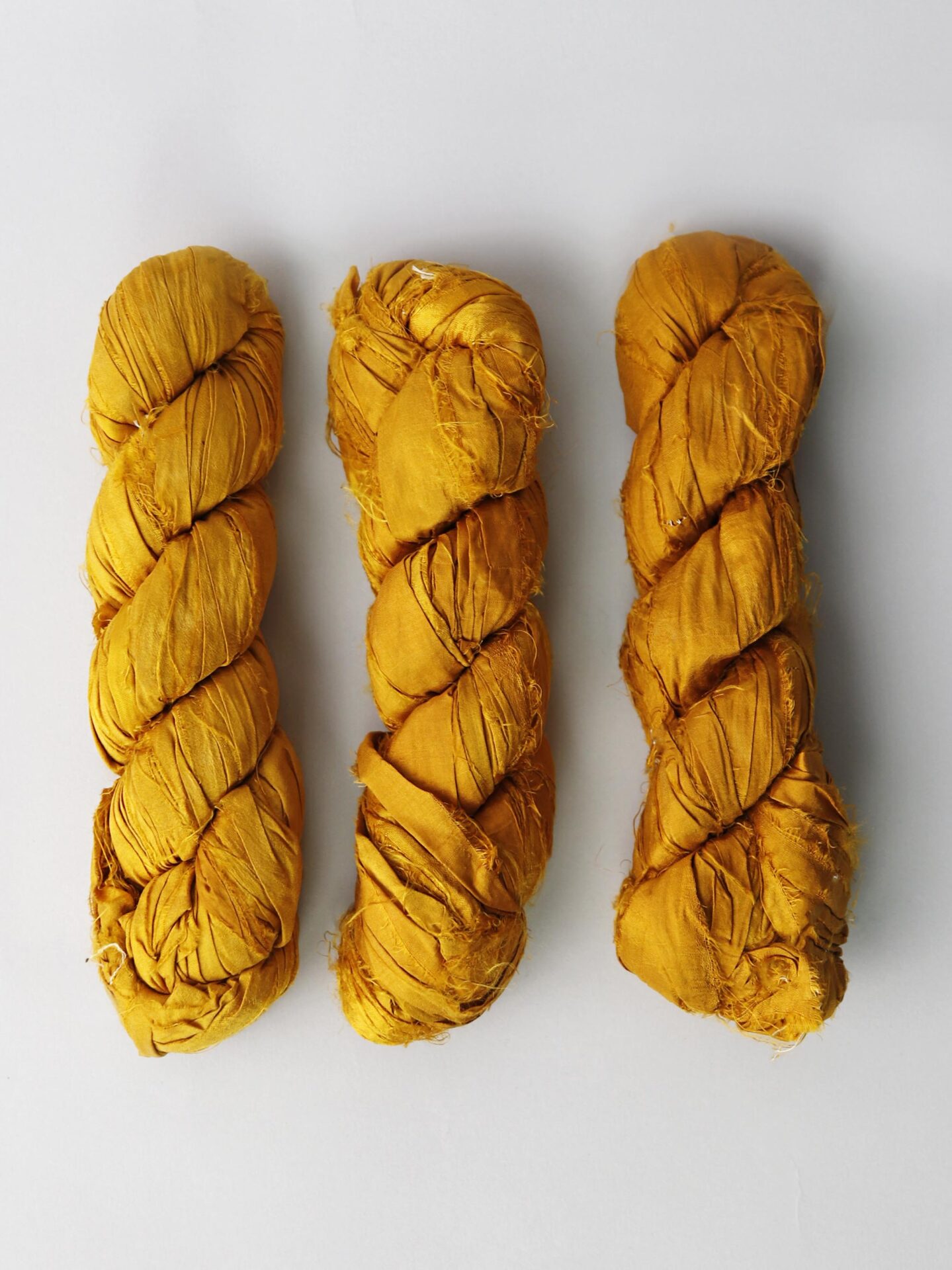
Sari silk ribbons represent the perfect meeting point between textile tradition, exclusivity and conscious sustainability. Made from pure silk, they originate from the recovery of fabrics that were originally intended for the creation of precious Indian saris, timeless icons of elegance and culture. This is why sari silk ribbons are part of the Rehab selection.
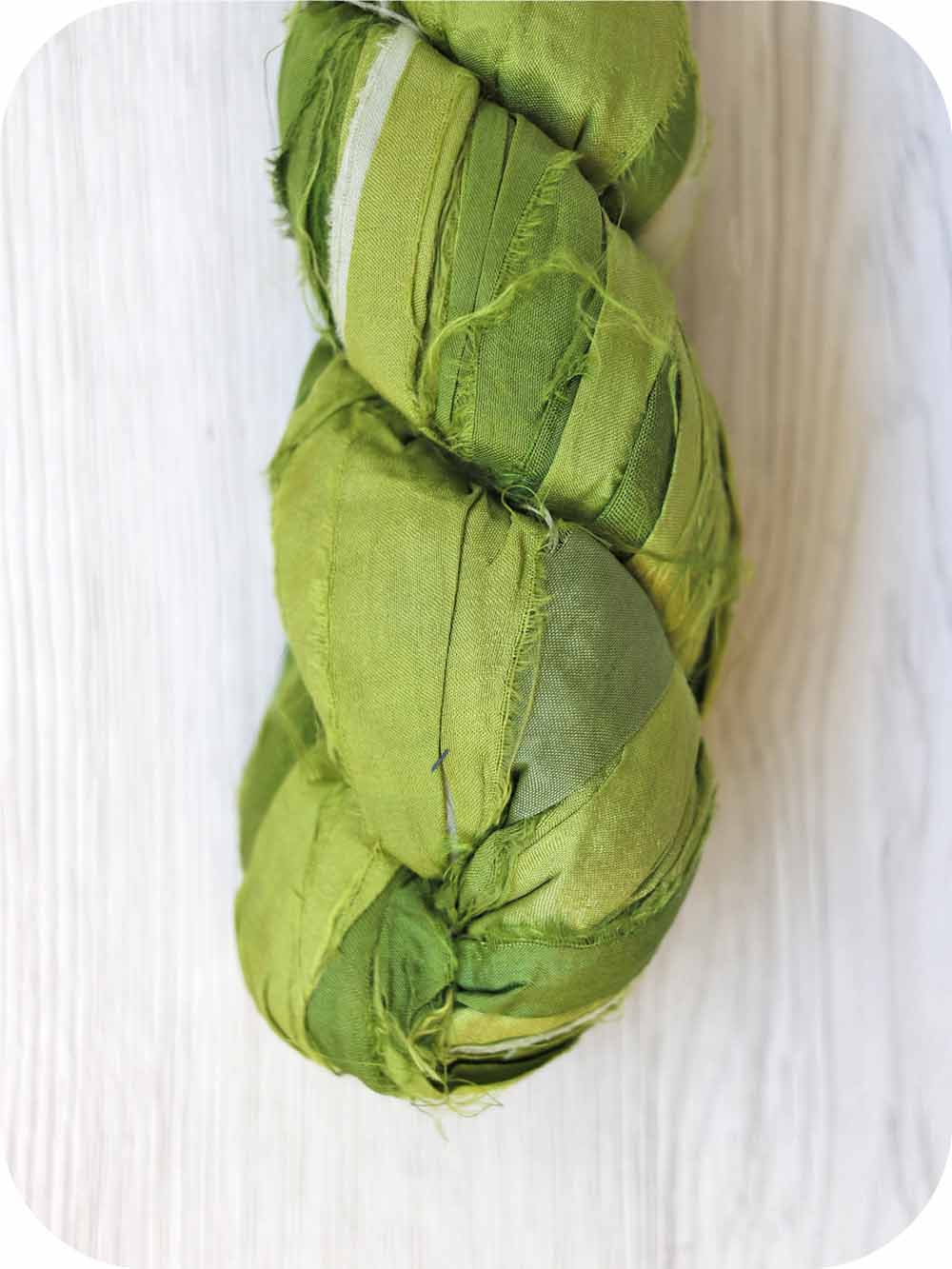
The shades, never perfectly uniform, create sophisticated and unrepeatable colour effects: each skein is a one-of-a-kind piece, where tones and textures blend into tactile harmonies with great character.
Availability and Packaging
These tapes are available in 100 g skeins that can be purchased individually. Each package has a natural tolerance of ±3%.
Length: about 50 yards per 100 g / 54.7 yards per 3.5 oz
Unlike sari ribbons commonly found on the market, which are often obtained from garments that have already been used and then reprinted or re-dyed, these ribbons are derived from surplus raw fabrics, selected before final use. A precise choice, resulting in superior quality dyes, made with certified dyes and processes that care for both the environment and people.
Their processing retains an authentic, artisanal charm: thin strips of silk are torn by hand and sewn one by one, resulting in a continuous ribbon then gathered into skeins. The deliberately raw-cut edges and slight irregularities in the yarn tell of the product's manual origin.
Sari silk ribbons do not come from a single area, but are related to the vast textile tradition of the Indian subcontinent, where the sari has been born and developed for millennia.
Today, sari ribbons are mainly derived from textile scraps from areas historically associated with silk, including:
Bottom line: the ribbons you find on the market are often a mix of provenances, because they come from surplus and salvage from the entire Indian textile supply chain.
The dyes used for our products meet the requirements of the OEKO-TEX standard, which ensures the control and limitation of substances potentially harmful to human health and the environment.
Fiber dyeing is carried out in our dyehouse in Italy, in compliance with current European regulations on chemicals and environmental safety, including the REACH Regulation (EC No. 1907/2006), which governs the registration, evaluation, authorization and restriction of chemical substances.
Operating within the European Union also entails compliance with additional provisions on environmental protection and textile product safety, such as the CLP Regulation (EC No. 1272/2008), relating to the classification, labeling and packaging of substances and mixtures. This regulatory framework ensures that dyeing processes are conducted according to high standards of safety, traceability and environmental responsibility, offering a reliable product for both the end user and the environment.
Silk sari ribbons are not a traditional yarn, but a textile material with an irregular structure, which can still be worked with different techniques. They can be used in needles or crochet, preferably with medium to large tools and simple stitches, to achieve soft and uneven workings.
They give particularly interesting results in loom weaving, especially as a weft, where they create textural and animated surfaces. Variations in color and thickness make each work different, without a uniform appearance.
They also lend themselves to other uses, such as textile decoration, applications on accessories or home decor, flower design or stationary projects. In general, they are suitable for work in which the irregularity of the material is enhanced rather than corrected.
CAUTION: All of our colors generally exhibit high lightfastness and fastness to washing. However, fluorescent colors (80's collection), in addition to having a lower lightfastness, may also suffer significant color loss in the presence of alkaline or particularly aggressive soaps, as well as with prolonged processing or washing. This phenomenon can occur, to varying degrees, even with dark and particularly bright colors. For materials dyed with these shades, we always recommend that a preliminary processing and washing test be carried out on a small sample before making the final design. This precaution is essential, especially when dyed materials are combined with unbleached or light-colored fibers.
Finally, to best preserve the colors, it is recommended that artifacts not be dried in direct sunlight, but in a shady place.