Caricamento carrello…
 Loading...
Loading...
Loading...Silk sari waste – sustainable creativity.
Rehab breathes new life into quality fibers and yarns, transforming scraps and leftovers into sustainable, creative materials ready to inspire your craft projects.
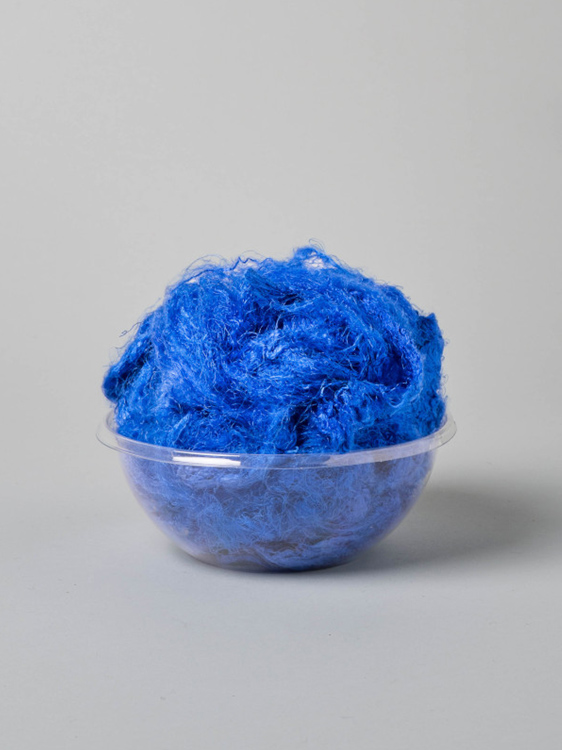
Silk sari waste is a natural silk fiber obtained as a by-product of the processing of silk fabrics intended for Indian sari production. During the spinning and weaving stages, a part of the shorter or irregular fibers is not destined for the main yarn, but recovered and selected to give life to this raw material with strong textile value. This is why sari silk waste is part of the Rehab selection.
Unlike other similar products on the market DHG waste is derived from the processing of raw (undyed) fabrics. This allows us to offer you a recycled material but at the same time guarantee high quality standards: in fact, all our colors are dyed in our facilities in Italy and meet Oeko-Tex Standard 100 standards.
Availability and packaging
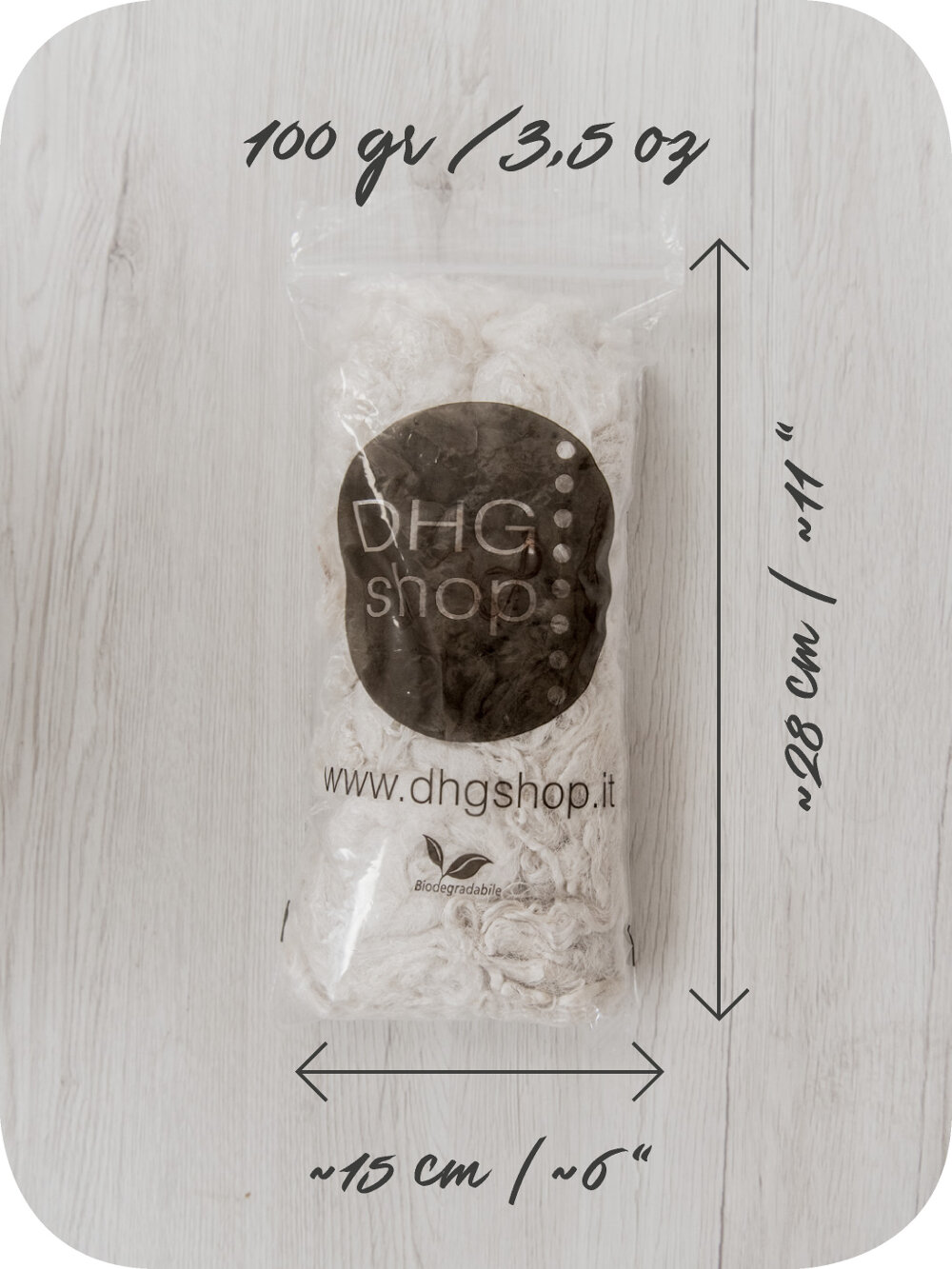
Sari silk waste is available in packages of 50,100 g, 500 g, 1 kg per color. Each package has a natural tolerance of ±3%. The different packages are designed for both those who need small quantities and those who need large quantities and/or want to save money. For non-ECE shipments, the packages are vacuum-packed, reducing volume and lowering shipping costs. Don’t worry: once opened, the waste returns to its original, fluffy volume with no loss of quality.
Silk sari waste is a discontinuous natural silk fiber obtained by the recovery of the shorter, irregular fibers resulting from the processing of silk fabrics. From a technical point of view, they appear as a soft and light fibrous mass, composed mainly of silk fibroin, with an unspun structure and therefore without filament continuity.
The fiber is characterized by a good softness to the touch, a natural luster typical of silk, and a slightly more "lively" and textural hand than continuous silk fibers. It has a high moisture-absorbing capacity, excellent breathability and good performance in the spinning stages, especially when blended with other natural fibers.
Because of its irregular nature, it can show variations in fineness and fiber length, characteristics that contribute to its authentic and uneven appearance.
Sari silk waste does not come from a single area, but is related to the vast textile tradition of the Indian subcontinent, where the sari has been born and developed for millennia.
Today, sari ribbons are mainly derived from textile scraps from areas historically associated with silk, including:
Bottom line: the ribbons you find on the market are often a mix of provenances, because they come from surplus and salvage from the entire Indian textile supply chain.
The dyes used for our products meet the requirements of the OEKO-TEX standard, which guarantees the control and limitation of substances potentially harmful to human health and the environment.
The dyeing of fibers is carried out in our dyehouse in Italy, in compliance with current European regulations on chemical substances and environmental safety, including the REACH Regulation (EC No. 1907/2006), which governs the registration, evaluation, authorization and restriction of chemical substances.
Operating within the European Union also entails compliance with additional provisions on environmental protection and textile product safety, such as the CLP Regulation (EC No. 1272/2008), relating to the classification, labeling and packaging of substances and mixtures. This regulatory framework ensures that dyeing processes are conducted according to high standards of safety, traceability and environmental responsibility, offering a reliable product for both the end user and the environment.
Silk sari waste is a discontinuous and irregular fiber, so it lends itself primarily to techniques in which the texture and variability of the yarn is an added value. They are ideal for artisanal spinning, either spindle or spinning, often blended with other natural fibers such as wool or cotton to improve cohesion and workability. Once spun, they can be used for knitting or crocheting, where they return soft, slightly irregular yarns that are very rich in texture.
They can also be used for needle felting or water felting techniques, where they integrate well with wool due to their fibrous structure, or for textile art interventions and three-dimensional decorations.
In general, they are designed for non-standardized processing, where the fiber is enhanced precisely in its free and non-regular nature.
Because colors may vary depending on the settings of the monitor or device being used, we recommend that you purchase our Color Folder to check the shades live before placing your final order. Want to check the quality of the material? Choose our Sample Box.
CAUTION: All of our colors generally exhibit high lightfastness and wash fastness. However, fluorescent colors (80's collection), in addition to having a lower lightfastness, may also suffer significant color loss in the presence of alkaline or particularly aggressive soaps, as well as with prolonged processing or washing. This phenomenon can occur, to varying degrees, even with dark and particularly bright colors. For materials dyed with these shades, we always recommend that a preliminary processing and washing test be carried out on a small sample before making the final design. This precaution is essential, especially when dyed materials are combined with unbleached or light-colored fibers.
Finally, to best preserve the colors, it is recommended that artifacts not be dried in direct sunlight, but in a shady place.