Caricamento carrello…
 Loading...
Loading...
Loading...Tussah silk waste – sustainable creativity.
Rehab breathes new life into quality fibers and yarns, turning scraps and leftovers into sustainable, creative materials ready to inspire your craft projects.
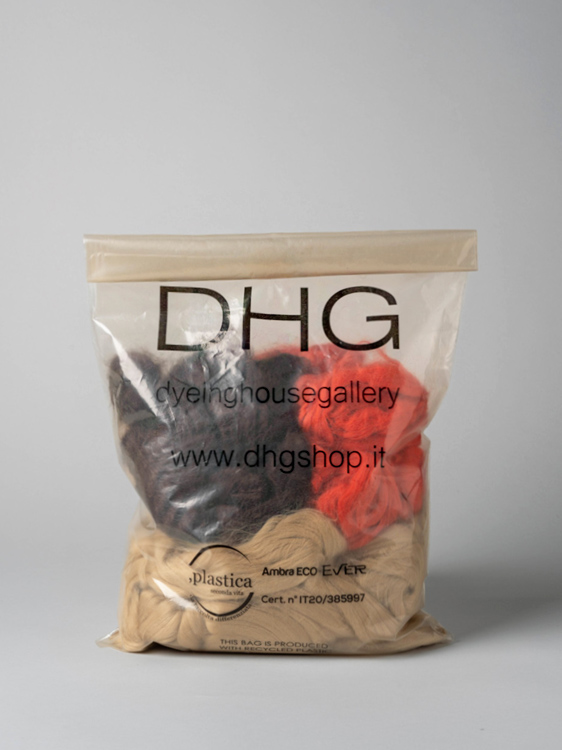
Tussah silk waste consists of selected fibers from our own production, often derived from tops or stockpile scraps. This approach not only helps reduce waste but also provides an opportunity to explore new creative and sustainable combinations. And that is why these materials are part of our DHG Rehab selection because they are fibers that are given a second life but have the high quality and characteristics of fibers in the collection and are perfect for felting, weaving, and hand spinning.
Buying these materials means making a sustainable choice, but you should also be aware that these packages have some limitations since the colors available vary according to production and the color assortment is limited nor is it possible to select color combinations within the package. However, we guarantee you that there are at least 2 different color shades inside.
Availability and packaging
This item is available in 500 g. Each package has a natural tolerance of ±3%.
For non-ECE shipments, packages are vacuum-packed, reducing volume and lowering shipping costs. Don’t worry: once opened, the silk returns to its original volume, as soft and fluffy as freshly processed, with no loss of quality.
Cascades of tussah silk.
Tussah (or Tussar) silk is a fiber of natural origin produced by silkworms that live in forest environments and feed on different tree essences, a characteristic that gives the fiber its typical natural color of beige and golden hues and a more textured texture than traditional silk. In contrast to mulberry silk, Tussah silk has generally thicker filaments and a slightly uneven surface, qualities that give the fiber an authentic appearance and a more textured hand, which is highly valued in handicrafts and creative projects that require character and naturalness.
Tussah silk is mainly produced in Asia, with a historical and established presence mainly in China and India, countries that represent the main centers of breeding and processing of this type of silk. Its production is closely linked to rural and forest regions, where silkworm breeding takes place in natural environments and follows traditional practices handed down over time. Even today, these areas constitute the heart of global Tussah silk production, helping to keep alive a silk industry rooted in Asian textile culture.
The dyes used for our products meet the requirements of the OEKO-TEX standard, which guarantees the control and limitation of substances potentially harmful to human health and the environment.
Fiber dyeing is carried out in our dyehouse in Italy, in compliance with current European regulations on chemicals and environmental safety, including the REACH Regulation (EC No. 1907/2006), which governs the registration, evaluation, authorization and restriction of chemical substances.
Operating within the European Union also entails compliance with additional provisions on environmental protection and textile product safety, such as the CLP Regulation (EC No. 1272/2008), relating to the classification, labeling and packaging of substances and mixtures. This regulatory framework ensures that dyeing processes are conducted according to high standards of safety, traceability and environmental responsibility, offering a reliable product for both the end user and the environment.
Tussah silk waste is perfect for needle felting.needle felting, forwater felting, for spinning, the hand weaving.
Since colors may vary depending on your monitor or device settings, we recommend purchasing our Color Card to check the shades in person before placing your final order. Want to check the quality of the material? Choose our Sample Box.
CAUTION: All of our colors generally exhibit high lightfastness and wash fastness. However, fluorescent colors (80's collection), in addition to having a lower lightfastness, may also suffer significant color loss in the presence of alkaline or particularly aggressive soaps, as well as with prolonged processing or washing. This phenomenon can occur, to varying degrees, even with dark and particularly bright colors. For materials dyed with these shades, we always recommend that a preliminary processing and washing test be carried out on a small sample before making the final design. This precaution is essential, especially when dyed materials are combined with unbleached or light-colored fibers.
Finally, to best preserve the colors, it is recommended that artifacts not be dried in direct sunlight, but in a shady place.